
The model (Hawton et al. 2012) below shows the causal pathways of self-harm & suicide. Each pathway has shared features, but leads to different outcomes.
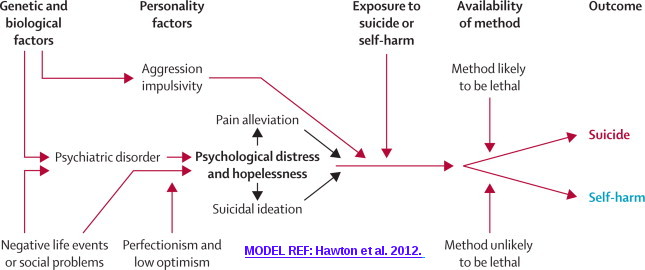
Clinical-based data posits self-harm on a risk spectrum that includes suicide.
Accidental death from self-harm is one of the common causes of injury-related adolescent death.
This means adolescent self-harm carries serious health risks.
In the UK public health services, Evidence Based Medicine (EBM) is the way standards of quality care are designed and delivered.
In EBM, randomised controlled trials are the “gold standard” of research evidence through the scientific model.
The Cochrane Library undertakes systematic reviews of the research evidence for public health interventions. For the review of interventions for adolescent self-harm, the 2015 COCHRANE REVIEW stated:
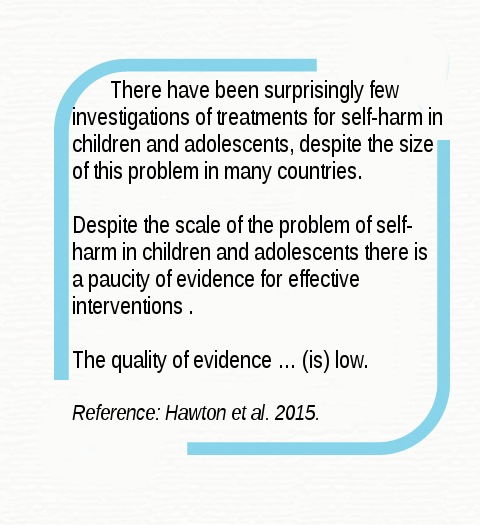
The review recommended the design of new interventions IN COLLABORATION with the adolescent self-harm population group, to ensure their needs are met.
This means finding ways to contact the “invisible” population group, to begin this partnership-based approach, when the traditional public healthcare networks and services only have access to a small population sample which is non-representative.
Therefore outreach exploratory research work with UK schools might be a feasible option in order to consult with young people about the health and support services they need/want in regards to adolescent self-harm.
This exploratory research can be used to gain much more detail about the context and needs, which will contribute to the design of future service support and interventions.
REFERENCES:
Grandclerk, S., Labroueh, D.D., Spodenkiewicz, M., Lachal, J. and Moro, M. 2016. Relations between Nonsuicidal Self-Injury and Suicidal Behavior in Adolescence: A Systematic Review. PLoS ONE 11(4): e0153760. doi:10.1371/ journal.pone.015376. See https://www.ncbi.nlm.nih.gov/pmc/articles/PMC4835048/pdf/pone.0153760.pdf
Hawton, K., Saunders, K. E. A. and O’ Connor, R. C. 2012. Self-harm & Suicide in Adolescents. The Lancet, 379 (9834), pp. 2373 – 2382. See http://thelancet.com/action/showFullTextImages?pii=S0140-6736%2812%2960322-5
Hawton, K., Witt, K.G., Taylor Salisbury, T.L., Arensman, E., Gunnell, D., Townsend, E., Van Heeringen, K. and Hazell, P. 2015. Interventions for Self-Harm in Children & Adolescents. Cochrane Database of Systematic Reviews. 12, pp.1 – 108.[Online] DOI: 10.1002/14651858.CD012013.
Hospital Episodes Statistics Analysis Team. 2015. Count of Finished Admission Episodes in England for Self-Harm (for ages 10 – 19 years) for 2006 to 2015. Leeds: Health and Social Care Information Centre.
Muehlenkamp, J.J., Claes, L., Havertape, L. and Plener, P.L. 2012. International Prevalence of Adolescent Non-Suicidal Self-Injury and Adolescent Self-Harm. Child & Adolescent Psychiatry & Mental Health. 6 (10). DOI: 10.1186/1753-2000-6-10
National Children’s Bureau/Association of School and College Leaders. 2016. Keeping Young People in Mind. Findings from a Survey of Schools in England. Available at: https://www.ncb.org.uk/news-opinion/news-highlights/school-leaders-voice-concerns-over-childrens-mental-health-care
NHS. 2017. Self-harm. Available at: http://www.nhs.uk/Conditions/Self-injury/Pages/Introduction.aspx
Wolfe, I., Macfarlane, A., Donkin, A., Marmot, M. and Viner, R. 2014. Why Children Die. Death in Infants, Children & Young People in the UK. London: Royal College of Paediatrics & Child Health and National Children’s Bureau. See http://www.rcpch.ac.uk/news-campaigns/campaigns/why-children-die/why-children-die-rcpch-campaign
World Health Organization. 2016. Practice Manual for Establishing and Maintaining Surveillance Systems for Suicide Attempts and Self-Harm. Geneva: World Health Organization.


You must be logged in to post a comment.