
THIS PAGE HAS ALL OF THE SITE’S RESEARCH MODELS & DIAGRAMS
THE MAJORITY OF INCIDENTS ARE INVISIBLE TO PUBLIC HEALTH SETTINGS.
This diagram gives an example of the proportion of teen self-harm that is hidden from public health services:
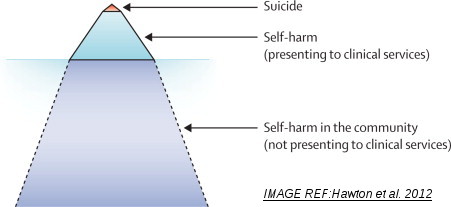
Epidemiological prevalence estimates are therefore hindered due to this “invisibility”. Estimates also vary due to differences in assessment methods, and within the diagnostic classification and terminology of self-harm (Muehlenkamp et al. 2012; World Health Organization, 2016 ).
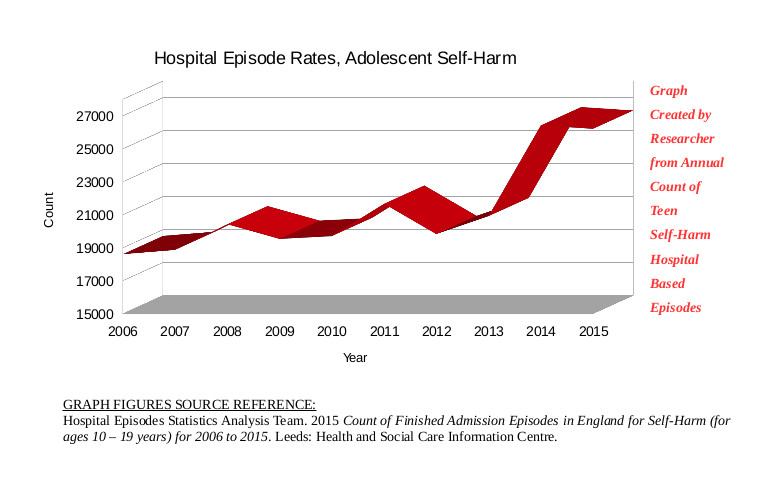
Over the last decade in the UK hospital episodes for teen self-harm have increased.
In the UK, there’s been an increasing teen self-harm rate from the year 2006 (18,611 teens) through to 2015 (26,216 teens), for the annual count of hospital-based episodes. From 2006 to 2015 there was therefore an increase of 41%.
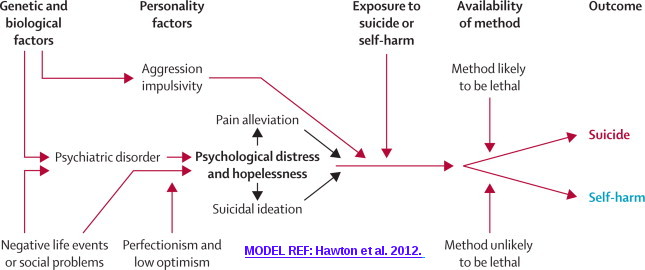
Hawton et al. 2012 – This is one posited model of the causal pathways of self-harm & suicide. Each pathway has shared features, but leads to different outcomes. This may explain the strong correlation between teen self-harm and suicide. This model posits the availability of method as a key factor.
REFERENCES:
Grandclerk, S., Labroueh, D.D., Spodenkiewicz, M., Lachal, J. and Moro, M. 2016. Relations between Nonsuicidal Self-Injury and Suicidal Behavior in Adolescence: A Systematic Review. PLoS ONE 11(4): e0153760. doi:10.1371/ journal.pone.015376. See https://www.ncbi.nlm.nih.gov/pmc/articles/PMC4835048/pdf/pone.0153760.pdf
Hawton, K., Saunders, K. E. A. and O’ Connor, R. C. 2012. Self-harm & Suicide in Adolescents. The Lancet, 379 (9834), pp. 2373 – 2382. See http://thelancet.com/action/showFullTextImages?pii=S0140-6736%2812%2960322-5
Hospital Episodes Statistics Analysis Team. 2015. Count of Finished Admission Episodes in England for Self-Harm (for ages 10 – 19 years) for 2006 to 2015. Leeds: Health and Social Care Information Centre.
Muehlenkamp, J.J., Claes, L., Havertape, L. and Plener, P.L. 2012. International Prevalence of Adolescent Non-Suicidal Self-Injury and Adolescent Self-Harm. Child & Adolescent Psychiatry & Mental Health. 6 (10). DOI: 10.1186/1753-2000-6-10
National Children’s Bureau/Association of School and College Leaders. 2016. Keeping Young People in Mind. Findings from a Survey of Schools in England. Available at: https://www.ncb.org.uk/news-opinion/news-highlights/school-leaders-voice-concerns-over-childrens-mental-health-care
NHS. 2017. Self-harm. Available at: http://www.nhs.uk/Conditions/Self-injury/Pages/Introduction.aspx
Wolfe, I., Macfarlane, A., Donkin, A., Marmot, M. and Viner, R. 2014. Why Children Die. Death in Infants, Children & Young People in the UK. London: Royal College of Paediatrics & Child Health and National Children’s Bureau. See http://www.rcpch.ac.uk/news-campaigns/campaigns/why-children-die/why-children-die-rcpch-campaign
World Health Organization. 2016. Practice Manual for Establishing and Maintaining Surveillance Systems for Suicide Attempts and Self-Harm. Geneva: World Health Organization.


You must be logged in to post a comment.