
This small scale project centred upon understanding the school-based context in regards to adolescent self-harm. It asked participants (through the use of participatory research methods), who resided within the school-setting, for their perspectives, drawing upon their considerable knowledge, insights and expertise of the context.
Process Evaluation
The information gathered from the research participants was used to create a theoretical model (of contextual influences). This work is informed by process evaluation, which consists of a set of components that function together to deliver this process. Process evaluation is used to understand the contextual factors in detail1 within intervention design and evaluation.
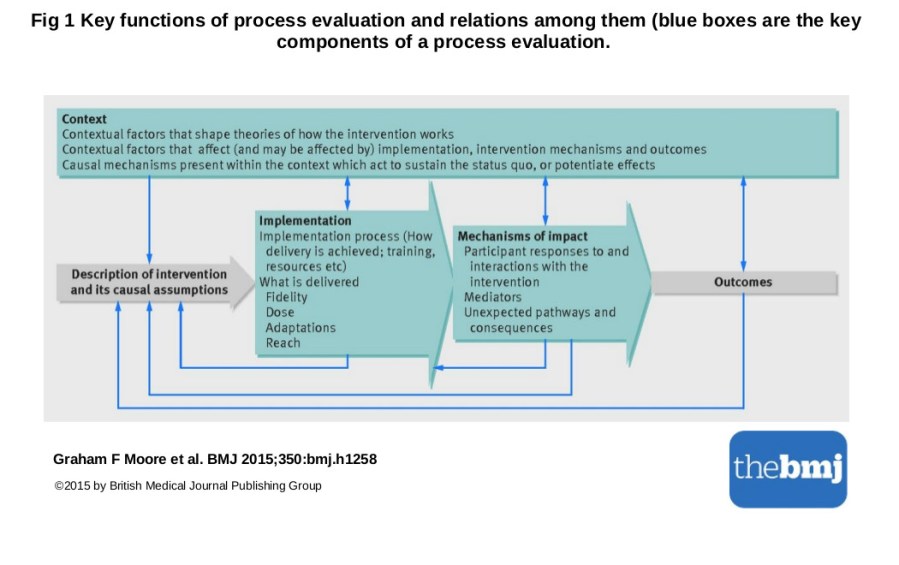
The theory that underpins this methodological approach is critical realism.
Critical realism2 is a theory of knowledge and methods (i.e an epistemology) that can utilise the perspectives of research participants (in the exploratory theoretical phase of Evidence Based Medicine3) to design theory. This theory can then be used to inform the logic models (within EBM), through process evaluation, to help in the design of support, through understanding the context in detail.
The Research Hypothesis
The research project explored the following hypothesis, that schools can be a feasible setting to provide protective factors for the adolescent self-harm population group. The development and examination of a theoretical model of the contextual influences upon adolescent self-harm in schools was generated within this work, from the information gathered from the research participants. This was a theoretical model of stigma, delineated in specific detail.
Please see the research findings here: The project’s results findings
The initial hypothesis was the generative structure that was tested through the research project, and elicited detailed information4 . Critical realism therefore enabled the underlying mechanisms to be revealed, and theory to be generated about reality, drawn from the starting point of the research journey as demonstrated by the initial research hypotheses which were tested within a real-world context for ecological validity5 .
Qualitative research methodology and critical realism
Critical realism posits that construction of knowledge for understanding a complex behaviour is not separate from social reality, and the phenomena under investigation is situated within a social context6 , in this case, the school-based context. This is why qualitative research methodology was used for the critical realist informed research design.
Qualitative research methodology facilitates in-depth information to be generated within the participatory research framework and is well suited to capturing detail, diversity and a plurality of perspectives which presents the context-dependent meanings and lived reality of participants. In this project, rich data was able to be gathered about real phenomena7 .
Qualitative research methods also enabled participants to be in the role of experts within their setting, who actively contributed and engaged with the research topic as they had important information, knowledge and lived experiences about the school-based context that an external person could not have access to, and to test theory; the critical realist interview process and subsequent data was theory-driven8 .
The Medical Research Council accepts critical realism for use as a meta-theory for understanding the contextual factors impacting complex intervention design9.
This means that a participatory qualitative research methodology can be incorporated for use within a public health research domain.
The research project was fully aligned with public health ontological and epistemological foundations that are fit-for-purpose for the school-based setting, the qualitative participatory research framework, and the focus upon understanding the causal mechanisms embedded within each of the separate social and cultural school contexts (from which shared generative mechanisms were further elicited).
Embedding the research proposal, design and methodology within the critical realist ontology and its specific methodological tools meant that the knowledge generation had ontological and epistemological validity, and permitted theoretical reasoning for external validity purposes10 .
FOOTNOTES:
1 Moore et al. 2015.
2Bhaskar 1989; Sayer 2000.
3 Medical Research Council 2000; Moore et al. 2015.
4 Fletcher 2017, p.184.
5 Smith and Johnson 2014, p.8.
6 Sayer 2000, p.115.
7 Sayer 1992, p.30.
8 Pawson, 1996.
9 Fletcher et al. 2016.
10Smith and Johnson 2014, p.10.
REFERENCES:
Bhaskar, R. 1989. Reclaiming Reality: A Critical Introduction to Contemporary Philosophy. London: Verso.
Fletcher, A.J. 2017. Applying Critical Realism in Qualitative Research: Methodology Meets Method. International Journal of Social Research Methodology, 20 (2), pp. 181–194.
Medical Research Council. 2000 A Framework for Development and Evaluation of RCTs for Complex Interventions to Improve Health. London: Medical Research Council.
Moore, G., Audrey, S., Barker, M., Bond, L., Bonell, C., Hardeman, W., Moore, L., O’Cathain, A., Tinati, T., Wight, D. and Baird, J. 2015. Process Evaluation of Complex Interventions. UK Medical Research Council Guidance. BMJ. DOI: http://dx.doi.org/10.1136/bmj.h1258
Sayer, A. 1992. Method in Social Science: A Realist Approach. London: Routledge.
Sayer, A. 2000. Realism and Social Science. London: SAGE Publishing.
Smith, S.P and Johnson, R.B. 2014. How Critical Realism Clarifies Validity Issues in Information Systems Theory-Testing Research. Scandinavian Journal of Information Systems, 26 (1), pp. 5-28.


You must be logged in to post a comment.