
Self-harm is when someone intentionally damages or injures their body. It’s usually a way of coping with, or expressing, overwhelming emotional distress (NHS, 2017).
NHS Information & Help Resources for Self-Harm. Available at: https://www.nhs.uk/conditions/self-harm/
Adolescents are defined by age as 10 to 19 years old (World Health Organization). The term “youth” is applied to 15 to 24 year olds by the United Nations.
THE MAJORITY OF INCIDENTS ARE INVISIBLE TO PUBLIC HEALTH SETTINGS.
This diagram gives an example of the proportion of adolescent self-harm that is hidden from public health services:
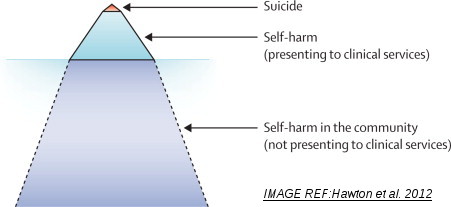
Epidemiological prevalence estimates are therefore hindered due to this “invisibility”. Estimates also vary due to differences in assessment methods, and within the diagnostic classification and terminology of self-harm (Muehlenkamp et al. 2012; World Health Organization, 2016 ).
Over the last decade in the UK hospital episodes for adolescent self-harm have increased.
In the UK, there’s been an increasing adolescent self-harm rate from the year 2006 (18,611 adolescents) through to 2015 (26,216 adolescents), for the annual count of hospital-based episodes. From 2006 to 2015 there was therefore an increase of 41%.
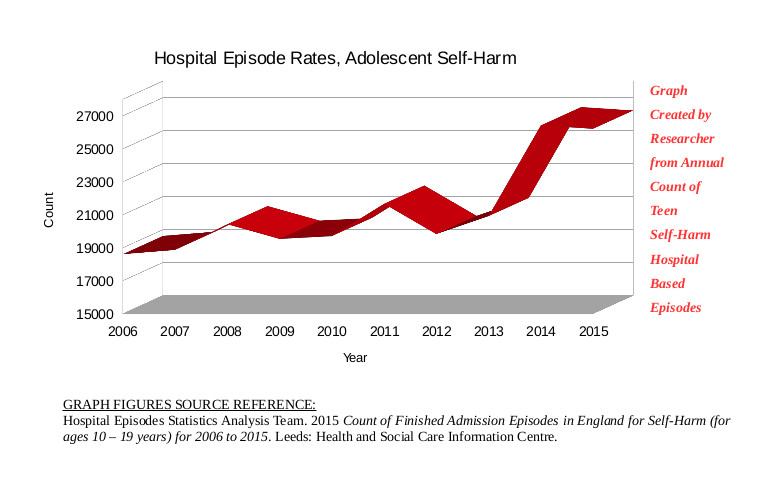
This means there may be a much greater prevalence of adolescent self-harm outside of public health settings.
UK schools are currently raising concerns about the increasing pupil self-harm rates in the context of the “worryingly high levels of mental health and well-being issues”.
National Children’s Bureau/Association of School and College Leaders. 2016.
REFERENCES:
Grandclerk, S., Labroueh, D.D., Spodenkiewicz, M., Lachal, J. and Moro, M. 2016. Relations between Nonsuicidal Self-Injury and Suicidal Behavior in Adolescence: A Systematic Review. PLoS ONE 11(4): e0153760. doi:10.1371/ journal.pone.015376. See https://www.ncbi.nlm.nih.gov/pmc/articles/PMC4835048/pdf/pone.0153760.pdf
Hawton, K., Saunders, K. E. A. and O’ Connor, R. C. 2012. Self-harm & Suicide in Adolescents. The Lancet, 379 (9834), pp. 2373 – 2382. See http://thelancet.com/action/showFullTextImages?pii=S0140-6736%2812%2960322-5
Hospital Episodes Statistics Analysis Team. 2015. Count of Finished Admission Episodes in England for Self-Harm (for ages 10 – 19 years) for 2006 to 2015. Leeds: Health and Social Care Information Centre.
Muehlenkamp, J.J., Claes, L., Havertape, L. and Plener, P.L. 2012. International Prevalence of Adolescent Non-Suicidal Self-Injury and Adolescent Self-Harm. Child & Adolescent Psychiatry & Mental Health. 6 (10). DOI: 10.1186/1753-2000-6-10
National Children’s Bureau/Association of School and College Leaders. 2016. Keeping Young People in Mind. Findings from a Survey of Schools in England. Available at: https://www.ncb.org.uk/news-opinion/news-highlights/school-leaders-voice-concerns-over-childrens-mental-health-care
NHS. 2017. Self-harm. Available at: http://www.nhs.uk/Conditions/Self-injury/Pages/Introduction.aspx
Wolfe, I., Macfarlane, A., Donkin, A., Marmot, M. and Viner, R. 2014. Why Children Die. Death in Infants, Children & Young People in the UK. London: Royal College of Paediatrics & Child Health and National Children’s Bureau. See http://www.rcpch.ac.uk/news-campaigns/campaigns/why-children-die/why-children-die-rcpch-campaign
World Health Organization. 2016. Practice Manual for Establishing and Maintaining Surveillance Systems for Suicide Attempts and Self-Harm. Geneva: World Health Organization.


You must be logged in to post a comment.